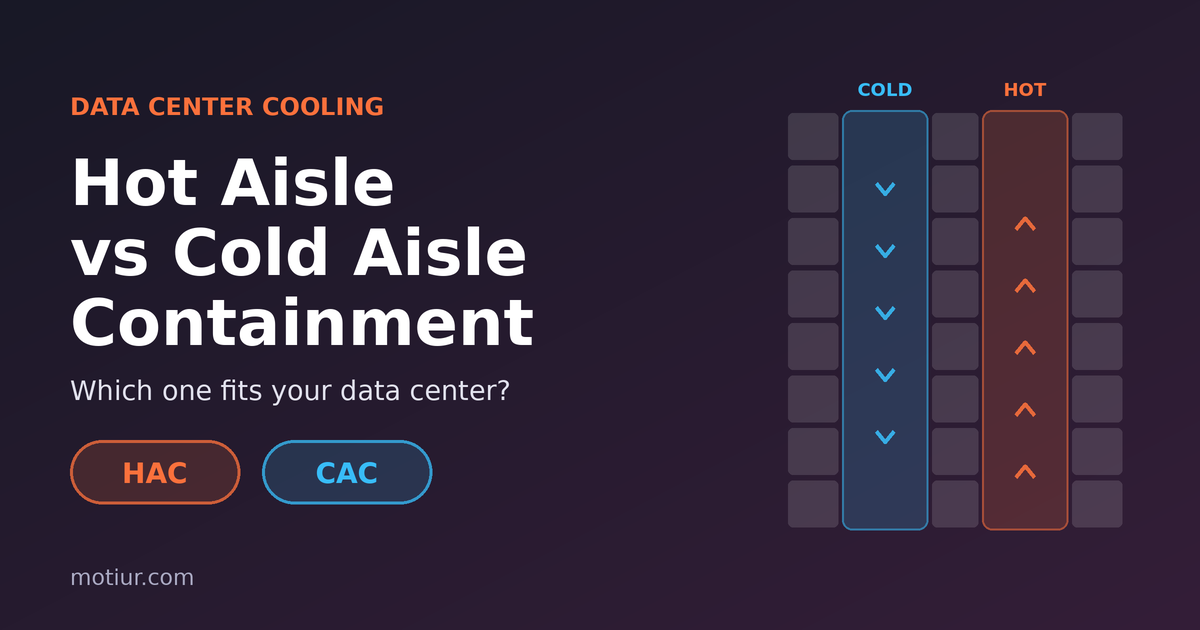
A data center can have plenty of cooling capacity and still run hot. The reason is often simple: cold supply air and hot exhaust air are mixing before they reach where they should. Containment fixes exactly that problem.
Why mixing air is a problem
Servers take in cool air at the front of the rack and push hot air out of the back. In an open room, some of that hot air flows back around the racks and into the server inlets. To compensate, operators lower the cooling setpoint, and that wastes energy. Precision air conditioning (PAC) units work best when the air returning to them is as warm as possible, and mixing works against that.
Two main approaches
Cold aisle containment (CAC)
The cold aisle between two rows of racks is enclosed with doors and a roof. Cold air from the cooling units stays in the enclosed aisle and can only pass through the servers.
- Works well with raised-floor designs and is often easier to add to an existing room.
- The rest of the room becomes warmer, which staff should expect.
Hot aisle containment (HAC)
The hot aisle is enclosed instead, and the hot air is carried straight back to the cooling units, often through a ceiling plenum or ducts.
- The rest of the room stays at a comfortable temperature.
- Needs a clear return path for the hot air, so it is easier to plan in new builds.
Containment only works if the basics are right
- Fit blanking panels in every empty rack space.
- Seal cable openings in the floor and rack tops with brush grommets or similar.
- Close gaps between racks and between the racks and the containment.
- Check airflow so the cooling units deliver what the servers need, not far more or less.
- Measure at the rack inlet. The ASHRAE recommended range for server inlet temperature is commonly quoted as 18 to 27 °C. Rack inlet sensors tell you more than the room average.
Do not forget fire safety
Containment changes how air and smoke move. Fire detection (such as VESDA) and any gas suppression system need to be designed together with the containment, and the design must meet local fire codes and the client's insurer requirements. This is a step that is easy to miss in a retrofit.
How I choose
- New build: I usually start by evaluating hot aisle containment, because it gives a cooler working room and a good return temperature.
- Existing raised-floor room: cold aisle containment is often the faster and lower-cost upgrade.
- In both cases, the best result comes from sealing leaks first and then adding containment, not the other way around.
Containment does not add cooling capacity. It makes the capacity you already have work properly.
If you are planning a new data center or want to reduce the cooling cost of an existing one, a site survey is the best first step. It shows where air is being wasted before any money is spent.